Monday, 18 February 2013

Vengeance as a funerary rite

All too often we hear on the news that efforts to prosecute a criminal, especially in the case of murder, are in order for the family of the victim to have closure. We seem to have an obsession with solving cold cases; letting a criminal run free for years on end is almost considered an offense to the deceased.

This idea isn't unique to modern "western" culture, the Native American "Blood Law," Anglo Saxon Weregild, "rido" in the Philippines (which is loosely based in family honor and shame) all look for some sort of retribution or price for murder.

Famously in the bible this passage from Numbers "Do not pollute the land where you are. Bloodshed pollutes the land, and atonement cannot be made for the land on which blood has been shed, except by the blood of the one who shed it" suggests that the slaying of a murderer is a method by which a victim can be atoned. While capital punishment is illegal in many parts of the world, there are plenty countries still believe it to be a legitimate process of law.

Gallows in Tombstone, Arizona.

If we look at the prosecution/punishment/slaying of a murderer in terms of a rite of passage, it could be seen to represent the final step, "reincorporation," where the "unknown" has been crossed, the mystery of the murder has been solved. Failure to atone for the victims' death leaves them in the unknown, and the rite of passage is unable to be completed.

In "cultures" where the death of a murderer is considered the only viable method of finding closure, the result is all to often to be feuds between groups, or outright war. As closure requires the murderer to be himself murdered, a chain of bloodshed results as the kin of the murderer in turn seeking vengeance for his death.

The Clan MacDonald-Clan Campbell feud of the 14th-17th centuries which culminating in the "Massacre of Glencoe" is in my mind the most famous example of a feud  Of course not all feuds initiated by vengeance, the case above has strong ties to religion, and aftermath of the Glorious Revolution. Regardless of the cause of conflict, it can easily be argued that the rite of vengeance is always a factor in prolonging a feud.

Romanticized depiction of the Massacre of Glencoe.

I could find an example of a feud elsewhere in the world, but I like Scotland, and any excuse to throw in "family" history, so I'll end this post by summarizing some events of the Gunn-Keith feud.

After the purported abduction of Helen of Braemore (whom was betrothed to an Alexander Gunn) at the hands of the Kieth Chief, the Clans Gunn and Keith agreed to a pitched battle. The terms for the battle were that each clan was allowed 12 horsemen and would be fought outside the chapel of St. Tears near Caithness. Clan Keith arrived with two men on each horse and slaughtered the warriors of clan Gunn.

One source that describes the battle (based on Sir Robert Gordon's "Genealogical History of the Earldom of Sutherland") states that "Their blood may be seen to this day [1764] upon the walls within the Chapel at St. Tyre, where they were slain." An emphasis is placed on the loss of blood, which represents the treachery of the Keiths and the overall feud.

The son of the Gunn Chieften (whom was slain in the battle) went on to ambush the Keiths decades later during a feast. After releasing several arrows through a window and into the chief of clan Keith, he is reported to have shouted "A Gunn's compliment to a Keith."

Gunn archer.

This feud involved significantly further bloodshed between the two clans prior to and after the above events, and was not officially settled until the 1970's. I have a hard time believing much of the information on the internet about this feud, but it certainly appears to be driven by a 500 year pact of vengeance between the clans.

Death is a difficult fact of life to deal with, and I guess some are more violent about it than others.

Tuesday, 12 February 2013

Gilded tombs do worms enfold

This weekend I went to the medieval studies' workshop on gold. While some archaeological examples were presented in the workshop, it mostly discussed gold in a literary context. Interestingly, most of the discussed sources portrayed gold as a corrupting agent with no material value. They seemed to suggest that those whom are able to reject material wealth will in turn have a higher status with God.

In particular, the medieval (Christian) renditions of Alexander the Great's conquests attribute the lust for gold as one of the primary reasons his empire fell apart after his death. They emphasize the uselessness of gold, with one tale having Alexander being served a meal of gold by a group of Amazons. Another told of Alexander's elaborate burial, and how being buried with so much gold did little to preserve his Empire.

So, while we generally perceive those whom are buried with the greatest value and quantity of grave goods to be of the highest status in a society, we should be careful not to dismiss those which have little, for the rejection of material wealth could certainly be its own form of status.

Thursday, 7 February 2013

What's that smell?

Last anth of death class had my prof discussing cremation. She mentioned that experimental archaeologists will often use pigs for recreating cremations as they are relatively similar to humans. This instantly (and disturbingly) had me wondering if people smelled tasty like pigs whilst being cremated.


A quick google search revealed this article from slate.
http://www.slate.com/articles/news_and_politics/explainer/2007/03/barbyou.html

Apparently I won't have an appetite for human any time soon.

Thursday, 31 January 2013

Keeping your head.

Today we consider the head to be one of the most critical parts the human body. Without it we lack visual, auditory, and verbal capacities. It also houses the brain, our most complex organ which acts as a centralized control point for all other organs in our body. While this post was originally meant to discuss the post-mortem significance of the head in a variety of cultures, it quickly deviated to being a post about head-hunting.


When investigating burials, one of the first things we note is the orientation of the head and body compared to nearby burials. Often we find some sort of decoration associated with the head, often in the form of a diadem, crown, wreath, or head dress. In modern western funerals, it is common for only the head of the deceased to be shown prior to burial, for this is how we recognize the individual.

A coffin opened to reveal the deceased's head.

Detaching the head and skull from the rest of the body for burial or treatment can be found among a number of cultures. The Maori of New Zealand are infamous for their Mokomokai, the tattooed mummified remains of their enemies' heads.


While fascinating in their own right, they also represent one of the biggest archaeological disasters ever. Due to extreme European interest in Mokomokai during the 19th century, the heads had become almost a form of currency with which the Moari could purchase firearms and other European goods. The demand became so great that tribes even resorted to outright war with each other in order to collect more heads for barter. As a result, heads found their way to museums and collections all over the world. Efforts to repatriate them to the Maori have lead to some very unfortunate circumstances.

Shrunken head from Peru.

Head-hunting wasn't exclusive to Maori, examples of the practice can be found from South America to Europe, to Polynesia. American WWII soldiers were even reported of collecting Japanese skulls as trophies.

Celtic Mythology has several references to the power of the head. While it appears to be debated among scholars, Roman sources mentioning the practice of Celts mounting heads on walls, provide strong evidence that Celts were Head Hunters. The apparent Celtic fascination with collecting heads is informally known as the "Cult of the Head."


The Hero of the Tain, Cu Chulainn, beheads a large number of foes through the course of his adventures. One case has him decapitating twelve foes and placing their heads on separate pedestals.

However, the archaeological evidence for Celtic head-hunting is nearly non existent. Some scholars suggest that this portrayal of Celts in myth was the result of Christian scholars barbarizing pagan Celts in their recording of their mythology.

I'm uncertain, and probably unqualified to make a guess at what drove the people of these cultures to collect the heads of their enemies. Perhaps they believed that heads held the soul, and holding heads held power over the enemy? Or maybe, head hunting was an infrequent practice in most cultures, and only emphasized by "civilized" peoples  to demonstrate how "barbaric" they were (as many argue cannibalism to be).

Anyways, I'll leave you with my necessary pop culture reference and favorite fictional example of head-hunting.


Wednesday, 30 January 2013

Mummified Cats/Playing with Scheduling

This post is just my attempt to see if I can make something post at 4:30 in the morning next week (or today, the 30th, if it publishes properly).

Snapped this a few years ago when I ended up in the Louvre. While packed with interesting and bizarre things, mummified cats topped the list for the strange. Apparently they were mostly made as sacrifices for Egyptian Gods, rather than grave goods.

What is really frightening is the fact that they still looked cute.

Saturday, 26 January 2013

Planning your own funeral is a dead end job

Terrible puns aside, this post will have me exploring how I would like the living to deal with my own remains.

What you take into the grave is ultimately the choice of the living. This became apparent to me at an early age, when I discovered that the little sticker on the edge of my care card meant that I wished for my organs to be donated to a hospital in the case of an accidental death. I wasn't appalled at the idea of donating my own organs, rather that my parents had made the decision for me without consulting me first.

Anyways, upon my death, I would like a burial. I have thought about other methods including cremation, sunk into the ocean, even being left to rot on a pike. In this post I will briefly explain my thoughts these methods, and why I ultimately chose a burial.

Cremation:
I find this a very intriguing way to deal with a body. The idea that you can have your remains spread in locations you strongly associate with is very tempting. Recently there have been several innovations in how one can choose to dispose of ashes, including launching them into space. An example follows.

Five years before his death, my Godfather requested that he be cremated, then have his remains turned into shotgun shells. At his funeral they were distributed among the attendees who were directed to fire them at a location they strongly connect with him. I still have one sitting on my desk; I'll deal with it some day.

I think the biggest draw to cremation is that your "essence," represented by your ashes, is free to flow where ever without restrictions of a grave. It also allows for multiple people to dispose of an individual as they see fit.

Naval Burial:

I find they idea of my body floating endless in the ocean whilst being nibbled upon by fishes to be a bit frightening. However, if I could have an entire casket launched into space, that would be an entirely different story.


Left on a Pike to rot:
 I'm not certain if this is even legal, but I find this an interesting way to be disposed of regardless. Like cremation, my "essence" (via the consumption by carrion) would be distributed throughout the world.

Burial:
While I don't affiliate myself with any religion, growing up in a small rural towns has conditioned me to strongly associate death with creepy graveyards, mourning, and most importantly, permanence. This is ultimately why I rejected the above funerary methods.

Once you are dead, you are dead. You no longer have influence upon the world. If you are cremated, or left at sea, there is no way that future generations can even know you existed. Being irreligious, I believe that once you pass, the only thing that happens too your being is nothing. You are dead; it's over.

A burial at least allows for you to make a permanent mark on the landscape. That is my general train of thought on death, which is a bit depressing.

"If you just want a permanent monument, why not be cremated then have your ashes buried?!"

The usual response for this is religious; God(s) has troubles resurrecting a corpse if it isn't intact. My reasoning is that some day, in the very far distant future, we could potentially gain the ability to reanimate corpses. Being a pile of ashes would likely make this difficult.


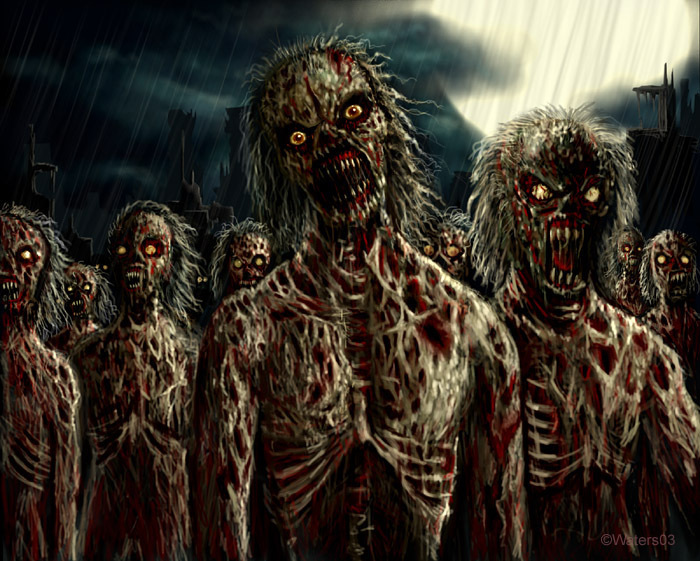
Being a fan of pop culture, I like to believe that this potential reanimation of corpses will come in the form of a Zombie apocalypse.

This is something I'd like to participate in.

Besides participation the apocalypse, a burial would also allow for the inclusion of grave goods. I think it would be great to be buried with a 12'' of "Live after Death," some ramen noodles, and one of Robert Jordan's books. Perhaps I would include some video-games, probably Zelda, Age of Empires or Final Fantasy IV.

For clothing, I'd want a suit, though with a kilt. Suits are traditional, and kilts are great.

I guess the fact that I'm thinking about including grave goods in my burial means that I believe there is something beyond death. Or at least consider it.

Anyways, thus ends a overly long, rambley and pessimistic blog post.

Ciao.

Tuesday, 22 January 2013

Yeah, no.

It doesn't look like there will be any Neanderthal clones any time soon. The media ate that one up quickly.

http://bostonherald.com/news_opinion/local_coverage/2013/01/harvard_professor_blasts_neanderthal_clone_baby_rumor_web

I'm terrible at physical anth, and this is a blog about death, so I don't have much to say on the topic besides that this represents an example of sensationalism overtaking sense in the media.

Unfortunately this also means that Neandertallica is still a ways off.